By: Joshua Rosenberg. April 1, 2026
The city of New Orleans killed a $5.4 million grant meant for recycling on Tuesday. At least one powerful, politically well-connected force had been angling for its demise.
A Solid Waste Infrastructure for Recycling for Communities (SWIFR) grant was originally awarded to the city by the U.S. Environmental Protection Agency (EPA) under the Cantrell administration in September 2023 for $3.9 million. A matching grant from the Recycling Partnership, a nonprofit organization dedicated to supporting recycling, along with other funding bumped that figure to above $5 million. New Orleans was one of 25 cities selected for the SWIFR grant. The grant would also have provided funding for recycling education and to develop a Solid Waste Master Plan.
Only about 2-4% of what’s consumed by those in New Orleans gets recycled, according to the city. The grant’s funds evaporated at the end of March, according to an analysis reviewed by The Rosenberg Brief.
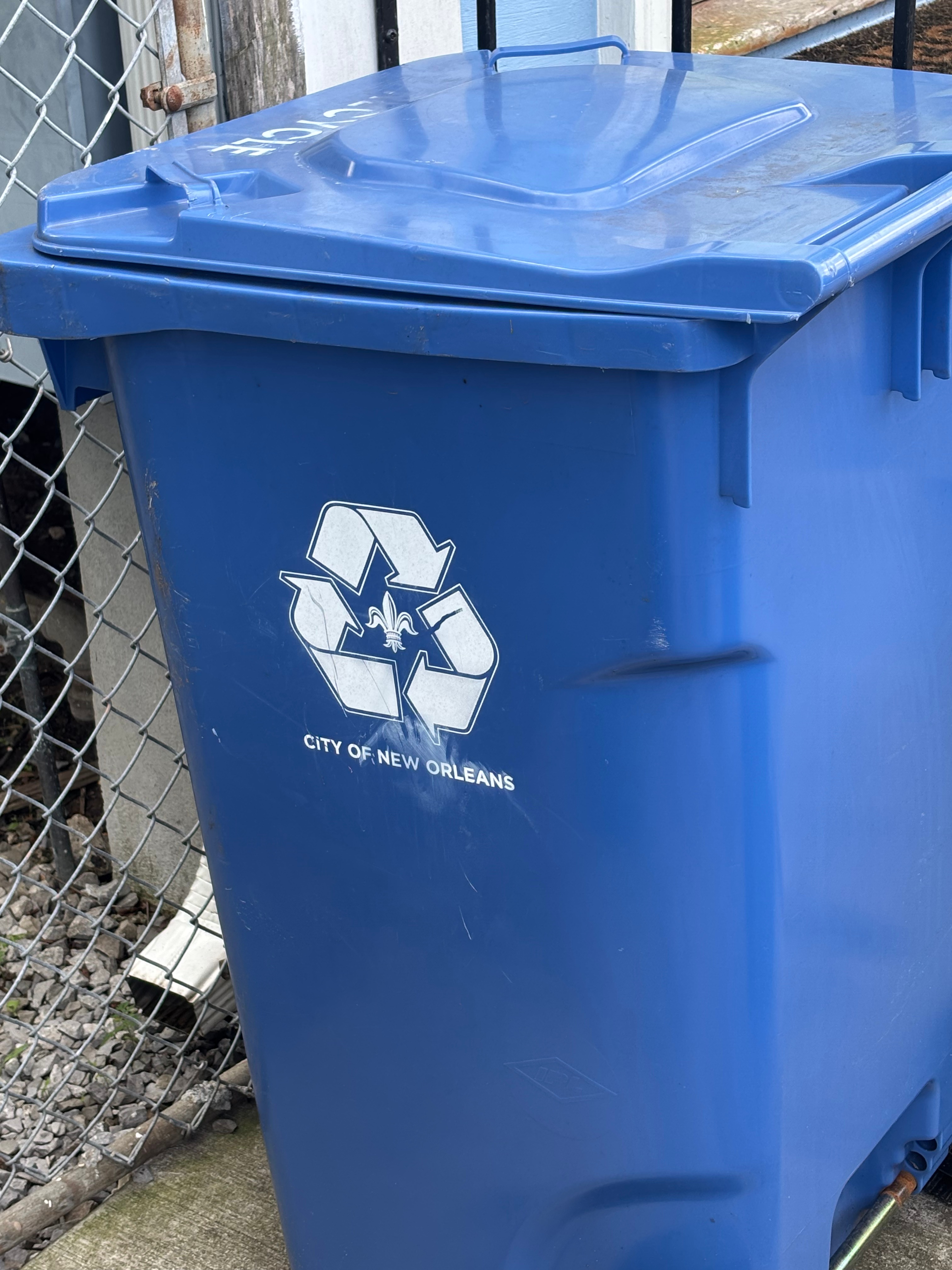
The grant would have provided the city with 83,000 residential recycling carts, turning our recycling system into an “opt-out” one instead of one that’s “opt-in.” Currently, less than half the city opts-in to recycling, a figure that breaks down largely along wealth and racial lines.
“Because of that disparity, and because we’re all paying into it, what it’s showing is that the Black community, the Black New Orleanian population is [essentially] subsidizing recycling for their white counterparts while not having the disposable income to do so because of the wealth gap, the wealth disparity… ” Chris Lang, who worked on the grant for the city as a Circular Economy Policy and Program Manager, told The Brief. “In order to move around that barrier, we were hoping to transition from an opt-in program to an opt-out program.”
Lang cited a study from The Data Center, published in 2024, which found the median net worth of white households to be $181,000, while that figure is $18,000 for Black households in the New Orleans metro area.
Not the city’s framing
The city is not saying it’s killed the grant.
“The City of New Orleans has requested a no-cost extension from the EPA for its Solid Waste Infrastructure for Recycling (SWIFR) grant, shifting the focus toward education, outreach, and long-term planning instead of a massive cart deployment,” the city said in a press release on Tuesday. “Residents can already request a free recycling cart by calling 311.”
But attempting to change the scope of the grant this late in the day is tantamount to killing it, Lang said.
“A guaranteed way to get your grant canceled after you have not spent any of the money for two years is to then all of a sudden change the scope of work…” Lang told The Brief.
That’s a sentiment shared by Osarumwense Adun, who runs the Noirlands account on Instagram.
“Despite being advised by multiple community members not to submit a ‘no-cause time extension’ with changed language to the grant, the [Helena] Moreno administration has decided to do so anyway, thus putting a nail in the coffin into the grant, and essentially making New Orleans a loser city,” Adun said on his channel.
To whose advantage?
New Orleanians currently pay for recycling, whether they use the service or not. $6 out of the $24 we pay in our monthly sanitation fees already goes towards recycling. And since 58% of the city doesn’t recycle, that’s essentially free money to the city’s trash collectors. In terms of households, the largest trash collector in the city is IV Waste, which is run by Sidney Torres. Torres, along with other waste-related people and organizations, is also a serious political donor. At times, Torres has, donated the maximum amount allowed by law to candidates, including Mayor Helena Moreno (then-councilmember) and New Orleans City Council President JP Morrell, both in 2025.
For instance, since 2017, Moreno received between some $84,000 and $144,000 in political donations from waste-affiliated companies and people, according to a tracker shared with The Brief.
Torres was actively opposed to the SWIFR grant, Lang said.
“Sidney Torres didn’t want to move forward with it,” Lang said, referring to the grant. “He said, ‘I will not ever support an opt-out program.’”
IV Waste denied neither that Torres actively opposed the grant nor that he worked behind the scenes to kill it.
“IV Waste fully supports and encourages public efforts to recycle as we are currently doing now through the 311 system,” the company said in an emailed statement to The Brief. “Any professional and wise approach to recycle [sic] must include a well-considered and comprehensive plan which is sustainable both in terms of concept and in fiscal responsibility. The city must be able to afford the plan short term and long-term.”
IV Waste, along with other waste haulers, collect $6 million in profits from the current recycling status quo by essentially not providing a service that New Orleanians already pay for, according to an analysis reviewed by The Brief.
The SWIFR grant did not die a neglected death. Lang and others, dating back to January, repeatedly emailed New Orleans City Councilmembers to schedule a public hearing regarding the grant. Their efforts were mostly denied, ultimately.
Who is affected?
The impacts of poorly managed solid waste management systems are most acutely felt by those with the least social standing and ability to effect change, according to a body of scholarly research.
The stakes are life and death, argued Lang.
“This is not just a throwaway issue,” he said. “It’s throwing people’s lives away prematurely.”
“There’s a whole ecosystem of people who are like this is f*cking corruption,” he said. “This is collusion. [It’s] corruption to kill this grant, which has severe equity concerns. It’s doubling us down In the business-as-usual which, in my own research, equates to premature Black death.”
Update: This story has been updated with more information. 4/1.
Leave a Reply